+12
SEO Score
+52
AI Readiness
24h
Time to Impact
P1
Priority Actions
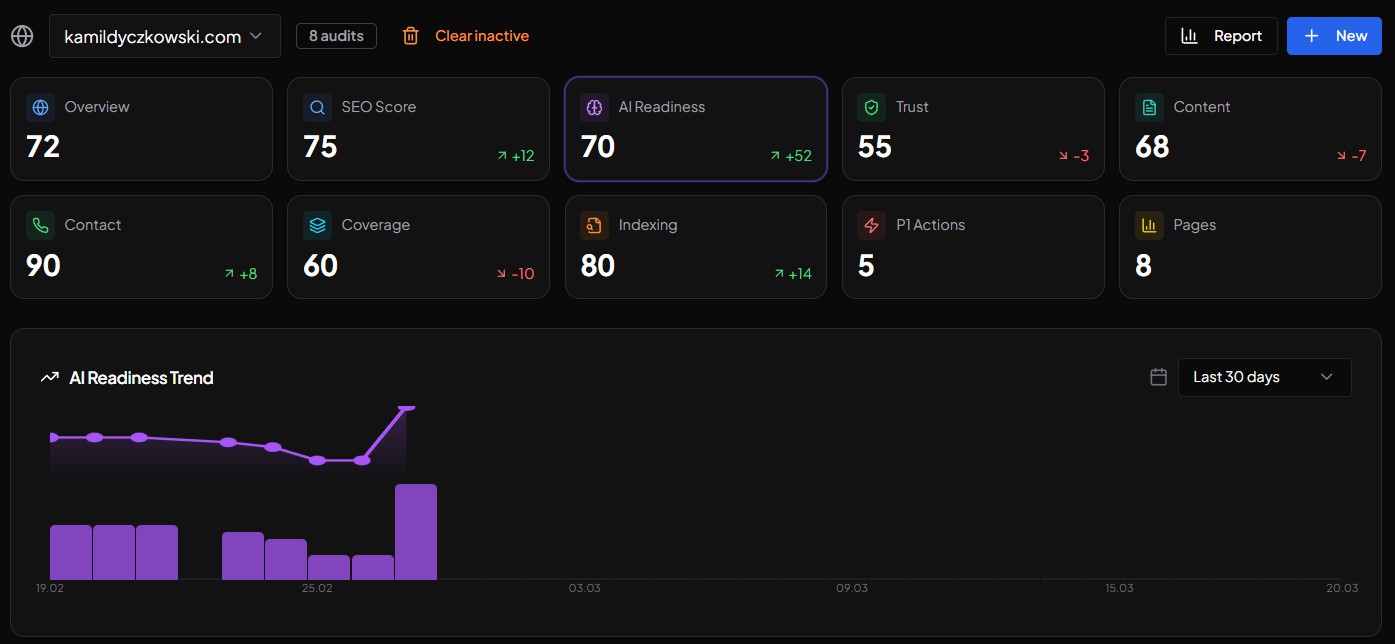
ScoreCite dashboard showing AI Readiness trend after structural implementation
How structural diagnostics delivered measurable SEO and AI Readiness improvement within 24 hours - without new content, link building, or paid traffic.
ScoreCite dashboard showing AI Readiness trend after structural implementation
Modern visibility is no longer determined only by rankings. It depends on whether a website is structurally interpretable, verifiable and contextually aligned with a specific market.
Most business websites are built for design and messaging. Very few are built for structural clarity. As a result, they contain hidden weaknesses - missing schema, broken hierarchy, weak trust signals, incomplete indexing logic or semantic inconsistencies.
These weaknesses are rarely visible to the owner. They do not break the website. They silently limit discoverability, interpretability and citation potential.
ScoreCite was created to diagnose that structural layer.
The goal is control and measurable improvement - not assumptions.
Business Solutions & Systems is the creator and owner of ScoreCite - a publicly available SaaS diagnostic system designed to evaluate structural visibility, trust alignment and AI-readiness of websites in a selected market.
This case documents the application of ScoreCite to kamildyczkowski.com as a controlled structural optimization test.
The website operates in the UK market and positions high-value bespoke operational systems. Despite strong positioning and clear offers, structural signals were incomplete. The audit was executed using ScoreCite (UK region selected).
All issues and prioritization were generated exclusively by ScoreCite. The system classified findings into P1 (Immediate), P2 (Mid-term), and P3 (Strategic).
The following actions were executed exactly as defined in the ScoreCite P1 Action Plan:
No new content was added. No link building was performed. No paid traffic was used.
Only structural and semantic corrections derived from the diagnostic report were implemented.
The improvement occurred within one reindexing cycle.
ScoreCite does not automatically modify websites. It performs structural diagnostics and generates prioritized corrective actions. The implementation in this case confirms that:
The ROI was achieved purely through structural correction and semantic clarity - without marketing amplification.
This case demonstrates that measurable visibility gains can originate from structural integrity rather than content volume or advertising spend.
For service-based businesses operating in competitive regional markets (e.g., UK), structural clarity directly affects:
ScoreCite provides the diagnostic control layer required to systematically improve those factors.
ScoreCite is a diagnostic system, not an automation engine. It identifies structural gaps and prescribes corrective actions. When implemented, those actions can produce rapid, measurable impact.
This case demonstrates what happens when structural weaknesses are identified and corrected with prioritization.